
India vs England, Commonwealth Kabaddi Championship 2026, Match 4: A Young Squad, a Big Question, and a Fixture We Should Not Over-Read
भारत बनाम इंग्लैंड, कॉमनवेल्थ कबड्डी चैंपियनशिप 2026 का चौथा मैच अहमदाबाद के एक मल्टी-स्पोर्ट्स कॉम्प्लेक्स में खेला जाएगा और यह भारत का इस टूर्नामेंट में पहला मुकाबला है। भारतीय टीम में बदलाव किए गए हैं: कई प्रमुख खिलाड़ियों को आराम, कई युवा प्रतिभाओं को मौका; कप्तान सूरजीत सिंह, उपकप्तान नवीन कुमार। भारत पसंदीदा है क्योंकि ईरान और चीनी ताइपे इस संस्करण में नहीं खेल रहे। प्रसारण चैनल/प्लेटफ़ॉर्म की आधिकारिक पुष्टि उपलब्ध स्रोत में नहीं है — आयोजक के आधिकारिक चैनल से पुष्टि करें। विश्लेषणात्मक चेतावनी: कबड्डी के ऑल आउट और बोनस लाइन नियमों के कारण असमान मुकाबलों में बड़ा अंतर जीतने वाली टीम के असली स्तर का भरोसेमंद संकेत नहीं होता; इस टूर्नामेंट के आँकड़ों से युवा भारतीय खिलाड़ियों का मूल्यांकन करते समय विरोधी की कमज़ोर गुणवत्ता का डिस्काउंट अनिवार्य है। भारत की वास्तविक ताकत का बेंचमार्क घरेलू प्रो लीग है, और असली परीक्षा ईरान के खिलाफ पूरी ताकत वाले मुकाबले में होगी।
India and England meet in Match 4 of the Commonwealth Kabaddi Championship 2026 in Ahmedabad. It is India's first fixture of the tournament — the tournament's fourth match, but the host nation's opener. The available material states that India have rotated their squad, rested several key players and handed opportunities to a number of young talents, with Surjeet Singh as captain and Naveen Kumar as vice-captain. India enter as one of the favourites, while Iran and Chinese Taipei — the two sides normally described as India's major rivals — are absent from this edition. That absence, not the fixture itself, is the most consequential fact about this match.
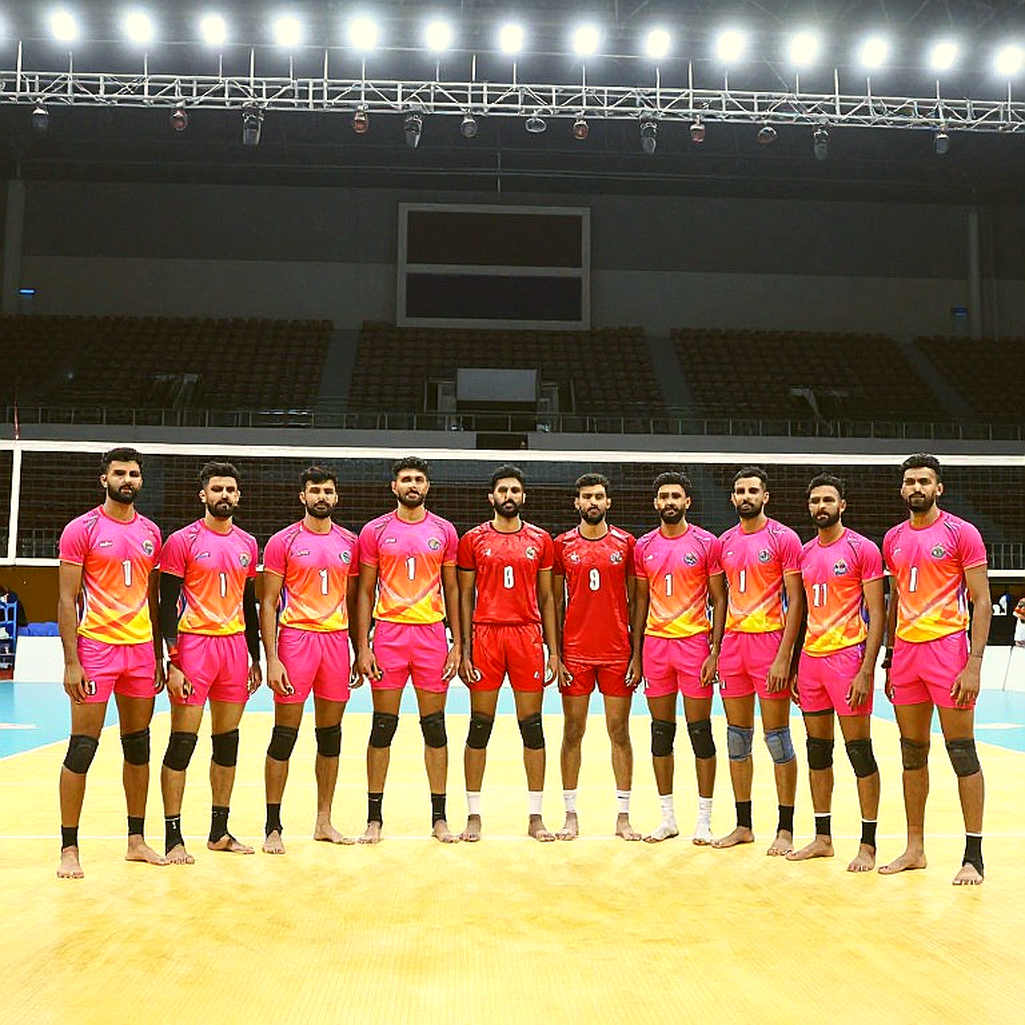
This report does not pretend to be more than a viewing guide with analysis attached. There are no raid points, no successful raid percentages, no tackle efficiency figures, no head-to-head data and no measurable description of either squad's depth. What exists is a fixture, a declared leadership structure, a rotation policy, a list of absent rivals and a geographic-cultural context. Everything below is therefore conditional, and where data is missing it is marked as such.
Kabaddi explained for readers who have never watched
Kabaddi is a 7-a-side team sport on a 13m × 10m court in which offence and defence alternate. Think of it as a competitive version of a schoolyard chasing game, combined with wrestling-style contact and a 30-second shot clock. A raider crosses into the opposition half within 30 seconds, scores by touching one or more defenders, and the point only counts once he returns to his own half. Defenders score by tackling the raider inside their own half. The raider must chant 'kabaddi, kabaddi' continuously throughout the raid to prove he is not holding his breath; if the chant breaks, the raid is void — kabaddi's unique anti-stalling rule. A bonus line deep in the opposition half gives one point when the defence has six or more players on court. An all out — when every player on one side is out — gives the opposition two extra points and revives the entire team. After two consecutive empty raids, the third becomes do-or-die: score or be out. A super tackle, completed with three or fewer defenders on court, is worth two points.
Why the scoreline will mislead you
Matches are two 20-minute halves, roughly 40 minutes in total, and scoring is fast: 1 per touch or tackle, 2 for an all out, 2 for a super tackle, 1 for a bonus. Against a side of England's level, Indian raiders' touch efficiency tends to produce early all outs. Each all out revives the opposition — handing them a fresh chance — while also giving India two extra points. The net effect is that scorelines in such fixtures systematically overstate the winner's true level. A 55-25 margin would tell us India are better than England; it would not tell us the young Indian side is world class. The bonus line compounds this: if England field a full seven-man defence, Indian raiders can farm single points by crossing it. This is technically undemanding and severely inflates individual raid statistics — a key caution for anyone using this tournament's data to evaluate the young squad. The 30-second round means small-sample volatility is high; one strong half can produce an eye-catching individual line that says little about season-level ability.
India: leadership spine, young periphery
The Surjeet Singh (captain) and Naveen Kumar (vice-captain) pairing suggests a deliberate structure: leadership continuity at the centre, experimental personnel around it. The rotation is the single most consequential competitive fact available. India are optimising for squad-depth discovery, not for margin of victory. The correct evaluation metric is therefore 'how many new caps look tournament-ready', not the scoreline.
There is an important caveat. 'Surjeet Singh' and 'Naveen Kumar' are common names in Indian kabaddi, shared by multiple players across roles. The source gives no state or franchise affiliation, so neither player's exact role or calibre can be fixed. What can be said is that the vice-captaincy going to a specialist raider suggests India's designated go-to scorer for this tournament is an established league-level player, with young talents rotating around him. That, paradoxically, may make this side more dependent on one raider than the full-strength team would be. The number of all-rounders carried is not stated — a genuine information gap, since India's rotation policy usually hinges on it.
England: a diaspora-built programme
England's men's programme rests largely on the British Punjabi community and has appeared at international-level events. Its competitive ceiling is well below Iran's and below the Asian top tier. A second-string India should still win comfortably. England's realistic objective is damage limitation and technical credibility — avoiding an early all-out cascade — rather than a result. Their squad is likely diaspora-selected: community-level athletes rather than a fully professionalised national programme. That matters for how their opponents' numbers should be read.
'Match 4' versus 'India's first match'
The two statements are consistent only if read as 'the tournament's fourth fixture' and 'India's opener'. It should not be read as the tournament's opening match. No format details are given: no confirmation of round-robin or group stage, no number of teams. If it is a short round-robin — implied by a fourth match arriving on day one — each team plays few matches, making this a mini-sample competition and further reducing data value. The venue is an urban multi-sports complex in Ahmedabad; the stadium is unnamed, so capacity estimates would be guesswork, though it is more likely a mid-capacity indoor arena than a cricket-style stadium.
A hollowed-out field
Kabaddi's international hierarchy is clear. India sit at the top. Below them the challenger tier: Iran, and Chinese Taipei in the women's game. Below that, the catch-up tier: Bangladesh, South Korea, England, Kenya, and circle-style Pakistan. At this event, both named challengers are absent. The field's second-strongest side is therefore materially weaker than the standard needed to test India, and a title here is a low-information achievement.
The source's own framing contains a tension. It simultaneously states that India's major rivals are absent and that India 'will need to deliver their best' and that 'unexpected results are always possible'. Both can be true in the abstract, but together they inflate a low-stakes fixture into a high-stakes narrative. The described rival set is also suspect: Chinese Taipei is a genuine power in women's kabaddi but not a men's heavyweight, so describing them as a major rival of the men's team suggests either a conflation or loose usage.
'Commonwealth' is a branding claim to treat cautiously. Kabaddi is not a Commonwealth Games sport, and a Commonwealth Kabaddi Championship is not an established top-tier property on the level of the Asian Games or the IKF World Cup. Its sanctioning body and edition history require verification — no governing body is named anywhere in the source, which is itself a signal. The correct benchmark for India's strength remains the domestic professional league, not this event.
Cultural and regional background
Kabaddi is effectively India's second-most-watched sports property behind cricket, and it carries a mud-born, pre-colonial, indigenous identity that makes it a vehicle for national pride in a way cricket cannot. It is best understood as India's folk-sport modernisation project. The Commonwealth framing is culturally, not competitively, motivated: it converts Punjabi diaspora communities in the UK, Canada and Australia into a participating, ticket-buying and streaming audience. The class-mobility narrative is central and authentic — most Indian kabaddi players come from rural, low-income households, and the sport is a genuine escape route through league contracts and railway, police and army jobs. That is why 'young talents given a chance' is not a neutral squad note but a social-mobility storyline. Gujarat as host fits a state-branding agenda as much as a development agenda. And the women's game is entirely absent from the source's frame, consistent with men's-only commercial packaging — a long-term talent-pipeline and internationalisation risk, given that women's kabaddi is Asian Games-recognised and has real depth.
Commercial and media ecosystem
The article's actual commercial function is search-intent capture: 'where to watch, when to watch'. That is an SEO-driven content format, not analysis, and it is itself a market signal — where the main value of coverage is 'where to watch', the rights are of limited value. No broadcaster, platform, channel, title sponsor or presenting partner is named anywhere in the source. That does not mean there is no broadcast; it means this report cannot verify one, and readers should confirm through the organiser's official channels. There is no auction mechanism at national-team level, so players here are unpaid or stipend-based. Ticketing and sponsorship data are unavailable. A significant share of the Ahmedabad crowd is likely local rather than national, reflecting Gujarat's appetite for sports events more than kabaddi-specific demand.
What this match can and cannot tell us
It can show young players' composure after early errors, their raid decision-making in do-or-die situations, defensive communication and cover-corner coordination, and the practical meaning of the captain-vice-captain structure. It cannot show whether they can handle Iran-style deep chain defence, whether they can contain elite raiders, or whether their best survives pressure. Because England's level is such that even a second-string India should win comfortably, the fixture cannot validate these players' ability to handle elite raiding pressure.
If India win comfortably, expect downstream media to recycle the 'India's dominance' narrative without noting the absences — a predictable inflation cycle. Any claim that a young player 'announced himself' here should be treated as narrative, not evidence: no supporting metrics exist in the source. Additional flags: rulebook edition not stated; 'favourites' asserted with zero supporting metrics; single-point dependence on the vice-captain likely; identity verification of both named leaders impossible without state or franchise identifiers; and complete silence on any player's recent form, which reinforces the development-tour reading.
Conclusion
This is a cultural-commercial product more than a sporting contest. India's participation is the anchor, diaspora identity is the market, and host-state branding is the political fuel. Competitively it is nearly settled; analytically it is nearly empty. The one genuinely interesting thing is selection politics — who India plays, who leads, and who rests — because that shapes the next cycle. The score comes after.
India's ability to rest its stars and remain favourite is itself the strongest evidence of the sport's structural imbalance: no other kabaddi nation has that depth. The real test is not England but the semi-final or final against the strongest remaining entrant — and the only fixture that truly calibrates India's standing is the next full-strength meeting with Iran.