From Mud to Mat: The Second Life of Kabaddi
कबड्डी एक संपर्क खेल है जिसमें मैट पर एक समय में सात खिलाड़ी होते हैं (12 सदस्यीय टीम)। पुरुषों का मैट 13×10 मीटर और महिलाओं का 12×8 मीटर होता है। रेड 30 सेकंड की होती है और रेडर को लगातार ‘कबड्डी’ कहते हुए विपक्षी आधे हिस्से से अंक लेकर लौटना होता है। कबड्डी 1990 बीजिंग एशियाई खेलों से पदक खेल है; भारतीय पुरुष टीम ने 1990 से 2014 तक लगातार सात स्वर्ण जीते, 2018 जकार्ता में ईरान ने स्वर्ण जीता और 2022 हांगझोउ में भारत ने वापस हासिल किया। महिला कबड्डी 2010 ग्वांगझोउ से एशियाई खेलों में शामिल हुई। प्रो कबड्डी लीग 2014 में आठ टीमों के साथ शुरू हुई और 2017 में 12 टीमों तक विस्तृत हुई। बांग्लादेश का राष्ट्रीय खेल कबड्डी है और ईरान एशियाई स्तर पर दूसरी बड़ी शक्ति है। कबड्डी अभी ओलंपिक खेल नहीं है।
Two Worlds, One Game
At five in the morning, a village akhada in northern India. Lines drawn in the earth with a finger, bare feet, and a single word repeated on one breath: kabaddi, kabaddi. The scene is centuries old, and the sport's roots sit in exactly that soil.
A few hundred kilometres away, inside a city indoor stadium, the same game wears a different face. Synthetic mat, floodlights, high-speed cameras, data on the coach's tablet, and a thirty-second raid clock ticking on the scoreboard. One sport, two entirely separate worlds.
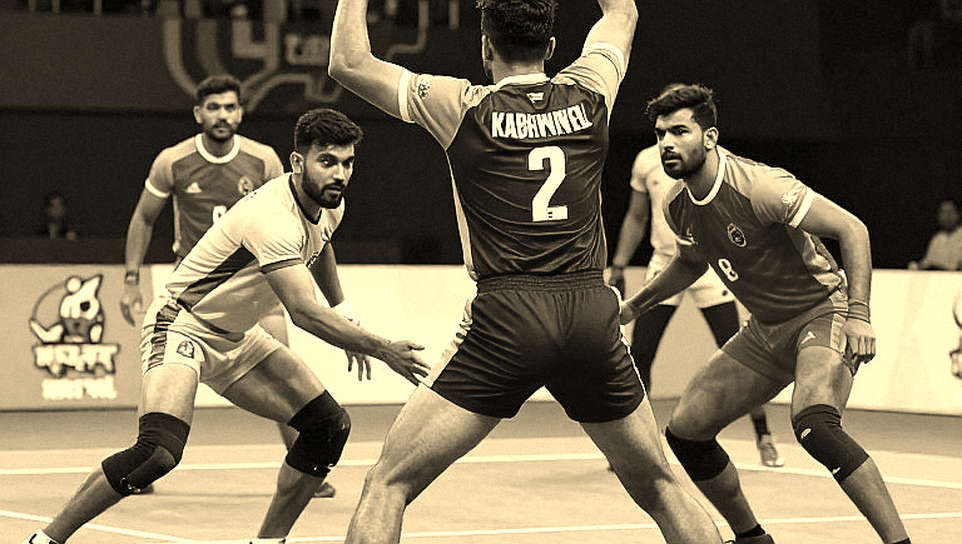
The bridge between those worlds is the most interesting story in modern kabaddi — a story not only about rules, but about economics, television, training science and rural social mobility.
The Structure of the Game
Kabaddi's greatest strength is its simplicity. Seven players per side on the mat, twelve in a squad. The men's mat measures 13 by 10 metres, the women's 12 by 8. No ball, no bat, no goalposts — just two halves, a midline, and the body.
The logic rests on two opposing actions: the raid and the tackle. A raider crosses into the opponent's half, has thirty seconds to score and must return safely — and must not break the breath, because the moment the chant of kabaddi stops, the raid is deemed over. That rule makes this a sport of lung capacity, and it is what separates it from every other team game.
Modern competitive kabaddi has layered on finer rules. The do-or-die raid: after two empty raids, the third must produce a point or the raider is out. The super tackle: two points for a successful tackle when the opposing side has six or fewer players on the mat. The super raid: three or more points in a single raid. The all out: two points and the revival of the entire side.
The revival system is where kabaddi's strategic depth lives. The game is never over — the harder a team collapses, the faster it can rise. Momentum that takes an hour to build in cricket or football can reverse in two minutes here.
Before and After the Asian Games
Kabaddi's organised history is often traced to the 2026 Berlin Olympics, where it appeared as a demonstration sport. But the real institutional beginning came at the 2026 Beijing Asian Games, when kabaddi became a medal event. Over the following decades the Indian men's team won gold in seven consecutive editions, from 2026 to 2026 — the longest unbeaten run by India in any team sport.
That run ended at the 2026 Jakarta Asian Games, when Iran beat India in the final. It was not merely the loss of a match; it signalled the end of a monopoly. India reclaimed gold at the 2026 Hangzhou Asian Games, but the contest was far tighter than it had ever been.
Women's kabaddi entered the Asian Games at Guangzhou 2026. India won gold in 2026 and 2026, Iran edged ahead in 2026, and India returned to the top in 2026. Iran's consistency is now the defining storyline of the sport: a country where kabaddi arrived not through domestic tradition but through organised sports science and a fitness culture.
2026: The Year the Sport Changed
If one date marks modern kabaddi's turning point, it is 2026 — the first season of the Pro Kabaddi League. Eight franchises, a prime-time television slot, celebrity owners, and a production framework that put a sport of the soil under floodlights.
The most concrete effect was on money. Before the league, a kabaddi player's income came largely from government jobs, railway or police recruitment, and prize money from local tournaments. After it, a market emerged in which a player's value was set by form, age and television presence.
In 2026 the league expanded from eight teams to twelve. The growth widened the map but created a new problem: supply of talent. There were not enough top-tier players to staff twelve squads. Teams began fielding very young athletes — which made the game faster and raised injury risk.
The Player Economy
The auction is the most transparent document of kabaddi's economy. Players are grouped into categories, each with a base price, and teams bid within a purse. The system balances two opposing forces: the market value of star players and the strategic needs of teams.
The real contest happens off the mat. An experienced raider is expensive; a good defender buys a team strength cheaply. The all-rounder is the most valuable category because he connects both halves of the side. Young players are the biggest risk-reward equation: low cost, high ceiling, unproven mental durability.
The weakness is career security. A player's livelihood is tied to the league calendar. Injury immediately affects income, because contracts are performance-linked and wage protection is limited. This imbalance is common in emerging sports, but it shows more sharply in kabaddi because alternative income streams are so few.
Training Science: The Body Is the Equipment
With no equipment, kabaddi's training centres entirely on the body. The demands are clear: explosive power for the burst of a raid and the grip of a tackle, flexibility through hips and ankles, and endurance for the thirty-second raid in which breathing must be suppressed.
Video analysis plays a central role. An opponent raider's habits — which foot he leads with, whether he favours the right or left, what he chooses in a do-or-die raid — are compiled before the match. Defenders' tackle timing and ankle-hold patterns are read the same way.
Injury burden is the sport's least discussed problem. Ankles, knees and shoulders are most affected, because a tackle stops and rotates the body abruptly. The mat changed joint loading compared with mud: falls became softer, but friction and abrasion increased. Rehabilitation and load management now matter as much as technique.
Women's Kabaddi: Growth and Gaps
Women's kabaddi has made measurable progress — consistent Asian Games medals, an expanding domestic circuit, growing state-level participation. But its visibility remains far below the men's game.
The roots of the imbalance are structural. For girls, staying in sport often means resisting social pressure from school to village. Where a family supports, talent develops quickly; where it does not, the pathway closes by seventeen or eighteen. The problem in women's kabaddi is not a shortage of talent but of continuity.
The Rural Base
Kabaddi's supply chain is unusual. There is no draft system, no college scouting — talent comes straight from the village ground. Hundreds of villages across Haryana, Uttar Pradesh, Maharashtra, Tamil Nadu, Karnataka and Punjab host night tournaments with cash prizes and real crowds.
The economic role of these tournaments is underrated. What a good local player earns over a few months is a serious sum for a household, and that incentive is what pulls children into the akhada. The league gave this pipeline visibility, but its foundation is the village fair and school sport.
Government structures — Khelo India, SAI centres, state academies — have added formal training. But quality varies enormously. Some centres offer scientific support; others offer only a ground and a coach. That inequality determines which talented child reaches the top and which stops on the way.
Technology: From Raid Clock to Review
Technology changed kabaddi in two ways: in the rules and in analysis. The raid clock, video review and clearer signalling made the game faster and less disputed. Decisions that once depended on a referee's eye are now settled on a camera frame.
In analysis the change runs deeper. Every raid, tackle and revival is logged, enabling questions that were previously unanswerable: which player has the best do-or-die success rate? Which defender concedes most in the final five minutes? Which team's first raid after an all out is weakest?
But data carries a trap. What can be measured starts to seem what matters. Kabaddi contains much that never appears in numbers — a decision taken under pressure, a team's morale, the instant a raider deliberately takes a risk. The best teams make data the servant of judgement, not its master.
Governance and the Calendar
In any fast-growing sport, administration rarely keeps pace. Kabaddi shows this clearly: the national federation, state units, the league's private structure and the international body do not always share interests.
The calendar is the sharpest example. The league window, national camps, international events and the domestic circuit are hard to reconcile. When they collide, the player pays: he either skips the league or skips playing for the country. No player wants to make that choice.
Doping and recruitment oversight have not strengthened in proportion to the money. This is not a uniquely Indian problem — every emerging sport follows the same sequence: money first, visibility second, oversight last.
Global Reach
Kabaddi is no longer only India's game. It is the national sport of Bangladesh and part of public life there. Iran adopted it through disciplined sports science and became a top Asian power. South Korea, Japan, Thailand, Malaysia, Kenya, Poland and Britain have organised structures.
The 2026 Kabaddi World Cup, played in Ahmedabad and won by India against Iran in the final, symbolised that expansion. But the irregularity of the international calendar remains a problem. Only consistently held competitions globalise a sport, and in kabaddi that consistency is still thin.
Kabaddi is not yet an Olympic sport, and that gap will persist for both financial and logistical reasons. Its stability at the Asian Games, and the possibility of Commonwealth Games inclusion, is the realistic path forward.
Four Priorities
First, player welfare. Salary protection, injury insurance, pensions and career-transition support are not luxuries but foundations. A league that holds players only on performance contracts damages its own long-term talent pool.
Second, a permanent structure for a women's league. A one-off tournament creates visibility, not careers. Women players need the continuity the men's game received.
Third, standardisation of coaching quality. India has good coaches, but their knowledge rests on personal experience rather than institutional curricula. Certification and continuing education can close the gap between a talented player from a village and a well-resourced one from a city.
Fourth, democratising data. High-level analysis currently belongs only to the bigger franchises. Making it available to state units and academies would raise the level of the whole system.
Conclusion
Kabaddi's greatest asset is accessibility. It costs nothing to play — only a patch of ground and seven people. That is why the sport offers a path to children from the poorest households, and why the league adopted it so quickly.
But accessibility alone is not sustainable. Having lifted its players from mud to floodlights, the sport's next task is to ensure the journey is not one-way. When a twenty-year-old raider returns from injury with nothing but a contract that may not be renewed, all the glare becomes meaningless to him.
The next decade will not belong to kabaddi alone but to its ecosystem. The rules exist, the audience exists, the money has arrived. What is needed now are the structures that carry that money to a player's career, a coach's competence, and a village ground.
At five in the morning, the child repeating kabaddi, kabaddi in the akhada is still invisible to any franchise scout. The future of the sport depends on how short and how reliable the road to him becomes.