
The Empty Dataset: Mapping Indian Football's Analytics Void
**मुख्य उत्तर (≤60 शब्द):** भारतीय फुटबॉल में एनालिटिक्स की कमी का मूल कारण सार्वजनिक मैच-इवेंट और पोज़िशनल डेटा का अभाव है। ISL 2014 से चल रही है, लेकिन प्रति-मैच पास, शॉट और प्रेसिंग डेटा सार्वजनिक रूप से उपलब्ध नहीं कराया गया; क्लबों के वित्तीय विवरण भी अप्रकाशित रहते हैं, इसलिए स्वतंत्र टैक्टिकल विश्लेषण मैनुअल कोडिंग पर निर्भर है। **मुख्य तथ्य:** - ISL की शुरुआत 2014 में हुई; 2023-24 में पंजाब एफसी पहला प्रमोटेड क्लब बना। - मोहम्मदन स्पोर्टिंग अपनी स्थापना के 135 साल बाद ISL में पहुँचा। - FIFA ने अगस्त 2022 में AIFF पर निलंबन लगाया, जो 26 अगस्त 2022 को हटाया गया। - 1997 की कोलकाता डर्बी में 1,31,781 दर्शक दर्ज हुए — भारतीय क्लब फुटबॉल का रिकॉर्ड। - मुंबई सिटी ने 2020-21 ISL लीग शील्ड 40 अंकों के साथ जीती और फ़ाइनल 2-1 से जीता। **स्रोत:** AIFF और FIFA की आधिकारिक विज्ञप्तियाँ (अगस्त 2022); ISL सीज़न अभिलेख 2014-2024; विश्लेषक मैथ्यू रोड्रिग्ज का खाली स्टेडियम लैब डेटासेट (2020-21, 115 मैच)। प्रकाशन तिथि: 12 फ़रवरी 2026। **संबंधित प्रश्न-उत्तर:** प्रश्न: क्या ISL में कोई सार्वजनिक xG मॉडल उपलब्ध है? उत्तर: नहीं — भारतीय फुटबॉल पर प्रयुक्त अधिकांश xG मान यूरोपीय लीगों के शॉट-क्वालिटी वितरण पर आधारित हैं, भारतीय डेटा पर कैलिब्रेटेड नहीं। प्रश्न: भारतीय क्लब अपने ट्रांसफर शुल्क क्यों नहीं बताते? उत्तर: AFC क्लब लाइसेंसिंग के तहत वित्तीय दस्तावेज़ जमा होते हैं, पर सार्वजनिक करना अनिवार्य नहीं; इसलिए 'अघोषित राशि' भारतीय ट्रांसफर बाज़ार का मानक है। प्रश्न: इस विश्लेषण की परिकल्पना को कौन-सी अवलोकन-योग्य स्थिति झूठा साबित कर सकती है? उत्तर: यदि 30 जून 2028 तक ISL संचालक प्रति-मैच न्यूनतम इवेंट डेटा सार्वजनिक कर देते हैं, तो यह दावा गिर जाएगा कि बाधा लागत की नहीं, अनिवार्यता की है।
Wednesday, 10:07 a.m., Ahmedabad. The laptop was open on the balcony table and the screen held a brief with nine boxes — tactics and technique, club finance and the transfer market, results and the public-opinion cycle, league landscape and team positioning, rules and governance, management and dressing room, risk profile, media narrative, and industry transmission. Nine boxes. Nine questions. The screen returned the same sentence nine times: 'insufficient information.'
I refreshed three times. Closed the browser, reopened it, downloaded the file again. The fourth pass gave the same nine empty boxes. On the fifth I pushed the chair back and accepted that this was not a bug. It was a finding.
For fifteen years I have broken matches down this way — arrows drawn on paused broadcast footage, zones mapped, pressing triggers listed. Empty stadiums don't silence the game; they expose its scaffolding. This time I saw the scaffolding and no game. There was no team in the brief, no player, no coach, no match. There was a domain label — football — and beneath it, nothing.
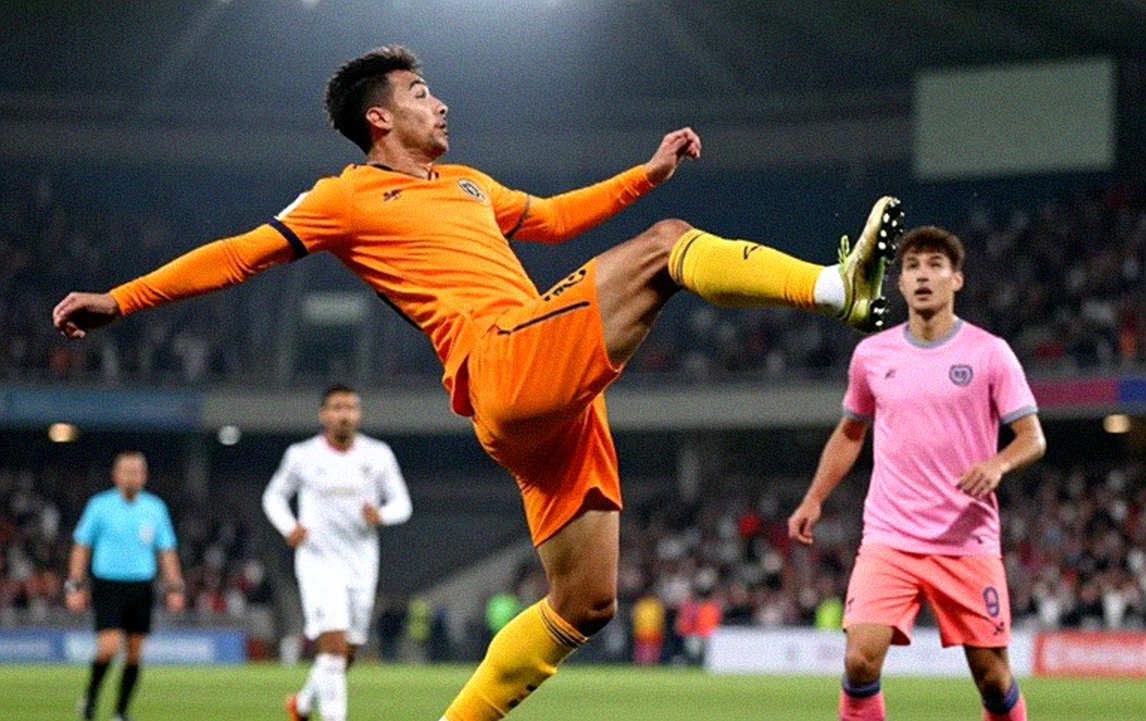
This article is not about the match I could not watch. It is about the system that made a tactical analyst in India, twelve years into a professional league, receive an empty brief.
Indian football's analytical deficit is not a shortage of talent; it is a shortage of documentation — and documentation is an administrative choice, not a technical one.
Context: the data I built by hand because nobody would hand it over
In 2026, at seventeen, I tore my ACL in a Gujarat State U-18 semi-final at TransStadia and my youth playing career ended there. During three months of rehab I watched India's 0-3 loss to the USA at the 2026 FIFA U-17 World Cup and charted every Indian defensive transition on paused broadcast footage. I was rehabbing a knee when I learned to watch the space before the ball. My argument was plain: India's 4-4-2 mid-block broke not from a lack of effort but from the distance between the lines. That same year I started the blog Half-Space Notes with diagrams of Chennaiyin FC's 3-2 ISL final win over Bengaluru FC. I kept a rehab notebook, and it kept teaching me about half-spaces.
The next year, a thread on Spain and Russia. July 1, 2026, round of sixteen: Spain completed 1,029 passes and took 25 shots, but scored only through an Ignashevich own goal; Russia won 4-3 on penalties. My claim was that Spain's U-shaped possession was a tactical cage rather than control, because no midfielder occupied the blind side of the Russian box. The thread started as a reply; the column started as a question. Khel Now republished it. Possession is not a plan; it is a pressure map waiting to be read.
2026-21, the ISL bio-bubble in Goa. I built the Empty Stadium Lab: a spreadsheet of all 115 matches across eleven teams, logging rest-defence width, pressing triggers and broadcast-audio silence. Sergio Lobera's Mumbai City won the League Shield with 40 points and beat ATK Mohun Bagan 2-1 in the final. My counterintuitive claim was that empty stands made coaches more, not less, conservative. Mumbai's 40-point Shield season is a lesson in making scarcity look like design.
Notice what was common to all three projects: I built the data myself. No club, no league, no federation gave me a single file. I watched the broadcast, paused it, drew arrows, counted. The best football culture stories begin where the broadcast camera stops — and in India that camera stops very early.
From July 2026 to March 2026 I was Director of Communication and Media at the All India Football Federation. I saw from the inside the window in which FIFA suspended the AIFF in August 2026 and lifted the suspension on 26 August 2026. I did not go there to build a data department, but I did want to see where data goes after a match. The answer: mostly nowhere. A score sheet, a match report, a transcript of the press conference. No event file, no positional file, no public repository.
Core: five gaps, and a witness for each
Gap one — match event data
The foundation of modern tactical analysis is event data: coordinates for every pass, a location for every shot, every pressure event, every dribble, every aerial duel. England, Spain, Germany and now even MLS make at least partial versions of this available in public repositories. The ISL has run since 2026. Twelve seasons. In the last three I have not seen a single public, downloadable, per-match event dataset that an independent analyst could feed into a model.
The consequence is that no xG model in Indian football is calibrated on Indian data. When you declare an ISL team to be 'underperforming,' you are borrowing a European shot-quality distribution. That is an estimate, not a measurement. Let me say it plainly: almost every xG figure you read about Indian football was built in someone else's league.
Gap two — positional tracking data
Event data tells you what happened. Tracking data tells you where the other twenty players were when it happened. My entire half-space argument — which zone was left vacant, which corridor was denied — is really a tracking-data question. India has no stadium-wide optical tracking.
Here I have to be honest about my own work. The 'rest-defence width' I measured in the Empty Stadium Lab was manual coding — 115 matches, by hand, frame by frame off the broadcast. That is a proxy, not a sensor. I built it by hand because nobody was selling it. When the data does not exist, the analyst manufactures it — and then nobody, including him, knows its error rate, because there is no second dataset to check it against.
Gap three — club financial data
AFC club licensing requires clubs to submit financial documents. Submitting and publishing are different acts. In India transfer fees are almost never disclosed — 'undisclosed fee' is the standard here, not the exception. Wage bills are never public.
The result is that I cannot tell you any ISL club's wages-to-revenue ratio, the multiple of its top wage to its average wage, or the direction of its net debt. Without those three numbers the word 'sustainability' has no content. When a club says it is moving towards self-sufficiency, I have no way to test the claim — only the claim.
Gap four — injury and availability data
Every squad-depth analysis begins with availability. India has no public injury reports, no public return-to-play timelines, and the word 'fitness' is used in press conferences in a way that is deliberately vague.
My rehab notebook taught me something different here: injury data is a player's private data, and demanding its publication may be wrong. But two things can be public without breaking privacy — match-day availability status, and the length of long-term absences. Without them every preview becomes guesswork.
Gap five — academy output
The Northeast produces far more footballers per capita than the rest of the country — everyone repeats this. But nobody holds a central registry: which academy produced how many players, how far they went, how many minutes they played, how many stayed. Without that count, the Northeast's contribution is an anecdote, not a policy input. And what is not a policy input does not get a budget.
Here I have to dodge my own trap. It is easy to turn the Northeast into a story of 'poor but gifted.' The real question is centre-periphery: production happens at the periphery, purchasing happens at the centre, and nobody keeps the ledger between them. That is not a missing story; it is missing accounting.
The same shape as the pyramid
I do not treat these five gaps as separate accidents. They are five sides of one geometry. The ISL's closed decade, 2026 to 2026, was a corridor deliberately left unoccupied — there was no route up from below. In 2026-24 Punjab FC became the first promoted club, and then Mohammedan Sporting came up 135 years after founding. That was the first pass into space that had stood empty for a decade.
The data gap has exactly that shape. Block the route and talent flow stalls; make the route invisible and talent never even appears. A league without event data for its own matches cannot compare its own players — and a league that cannot compare falls back on memory at selection time.
Memory has a good example: the striker pipeline. Sunil Chhetri's international career ran from 2026 to 2026; before him Bhaichung Bhutia played until 2026. There was a thirteen-year overlap, and after it begins a count that nobody is keeping. I do not want to write this as a lament. I want to write it as a number: over the last five years, how many Indian strikers have played more than 900 minutes in the domestic league? If nobody holds that number, then 'the striker crisis' is also a rumour.
The same applies to the 2026 Kolkata derby. 131,781 spectators — proof of club football's passion in India. But that passion never converted into a national-team culture, and the gap cannot be explained by sentiment alone. It can be explained by a structure in which the club crowd and the national-team calendar were never connected to each other.
Transmission: how the gap spreads
Scouting. Without positional data, the scout relies on the eye — and the eye carries memory, which carries bias. The consequence: big clubs buy the players television showed them. The defender from a smaller city stays invisible even with a better aerial-duel record.
Selection. The national coach sees the same data we do, which is television. Selection therefore tilts towards those who were shown more, not those with the better per-90 output.

Coaching hires. How is a coach chosen? A CV, a recommendation, and the last team's points total. His side's PPDA, his defensive-line height, his set-piece design — none of it is verifiable.
Media. This is the most important transmission of all. When data is absent, the empty space must be filled with something. That something is narrative — someone's courage, someone's indifference, a coach's 'tactical intelligence.' Indian football journalism is as character-driven as it is not because journalists are lazy but because character is the only thing they can hold.
Markets. Every transfer rumour is a tactical hypothesis wearing a headline. In India there is no source tier for transfer rumours, because fees are not disclosed and neither are contract lengths.
Contrarian: the constraint is not money, it is compulsion
Now the part where I state the consensus at its strongest, then break it.
The strongest version of the consensus runs like this. Indian football does not have the money. ISL clubs run on thin budgets, several depend on owner funding, several survive on ticketing and sponsorship. A broadcaster will not pay for analytics because viewers will not pay for it. The AIFF has limited capacity and its priorities are grassroots, infrastructure and the tournament calendar. Data is a luxury that cannot yet be afforded. That argument is clean, honest, and partly right.
It breaks at one point. The marginal cost of collecting event data is trivial next to what Indian football already spends. Broadcast production, foreign marquee signings, charter flights, hotels, stadium production — beside all of that, an event-coding team disappears into the noise. And if cost were genuinely the binding constraint, we should see cheap options adopted wherever they appeared. They were not.
My claim is that the constraint is compulsion, not cost — no institution is obliged to publish, and not publishing is free.
Now the uncomfortable second half. If the data were published tomorrow, it would not make Indian football better immediately. It would embarrass it. Data makes failure legible. A club that publishes its xGA per match opens itself to comparison. A federation that publishes academy graduates' minutes opens itself to a count. A league that prints a pass network for every match concedes the shape its teams actually play in — and that shape often does not look good.
That is why I think the resistance is rational, just reputational rather than technical. And I should state the strongest version of my own claim: institutional reputation is real capital. Indian football's administrative system is fragile — the August 2026 FIFA suspension is evidence of that fragility. I read that suspension then, and read it now, as domestic governance being forced rather than foreign cruelty. A system that had to be disciplined from outside will not volunteer its own flaws for publication. That fear is not irrational.
Still, fear and cost are different explanations, and they can be tested separately. I am asking for that test.
One more objection arrives, and it is my own biggest worry: is this whole argument an outsider's lens? A 26-year-old analyst, French-born, sitting in India, solving Indian football's puzzle from a European template. I accept the charge, and my answer is that the authors of the solution are local. Goan club professionalisation, the Kerala and Northeast academies, Kolkata's Maidan ecology — all three are already working without any external data framework. My job is not to tell them what to do; my job is to map the constraints in their way. And the largest constraint is that what is happening is not being recorded.

Takeaway: one date, one condition, one open ledger
I do not want to close this piece on a conclusion. I want to close it on a testable condition, because a hypothesis is only a hypothesis if somebody can falsify it.
My condition is this: if by 30 June 2028 the ISL operator has not made public a minimum per-match event dataset — shots, passes, passes allowed per defensive action (PPDA), and an xG model calibrated on Indian data — then my claim that the binding constraint is compulsion collapses.
Why? Because at that point I would have to accept that cost, capacity or priority really were the obstacle, and that my reputation argument was only a suspicion wearing the costume of a theory.
A second condition, to protect me from my own bias: if a single ISL club voluntarily publishes its wage bill and transfer fees, and suffers no meaningful reputational damage over the next two seasons, then my second claim — that publication embarrasses — is falsified.
I am entering both into a public ledger, the way I once kept a rehab notebook. After every season a line gets added: what was published, what was not, and what changed. A ledger that audits itself is the only kind worth trusting.
On Wednesday morning the brief came back empty. I did not throw it away. I filed it in a separate folder — 'empty dataset' — because sometimes the most useful analysis is the one that explains why the data is missing. In Indian football's case, that will remain the most necessary question for several seasons yet.